
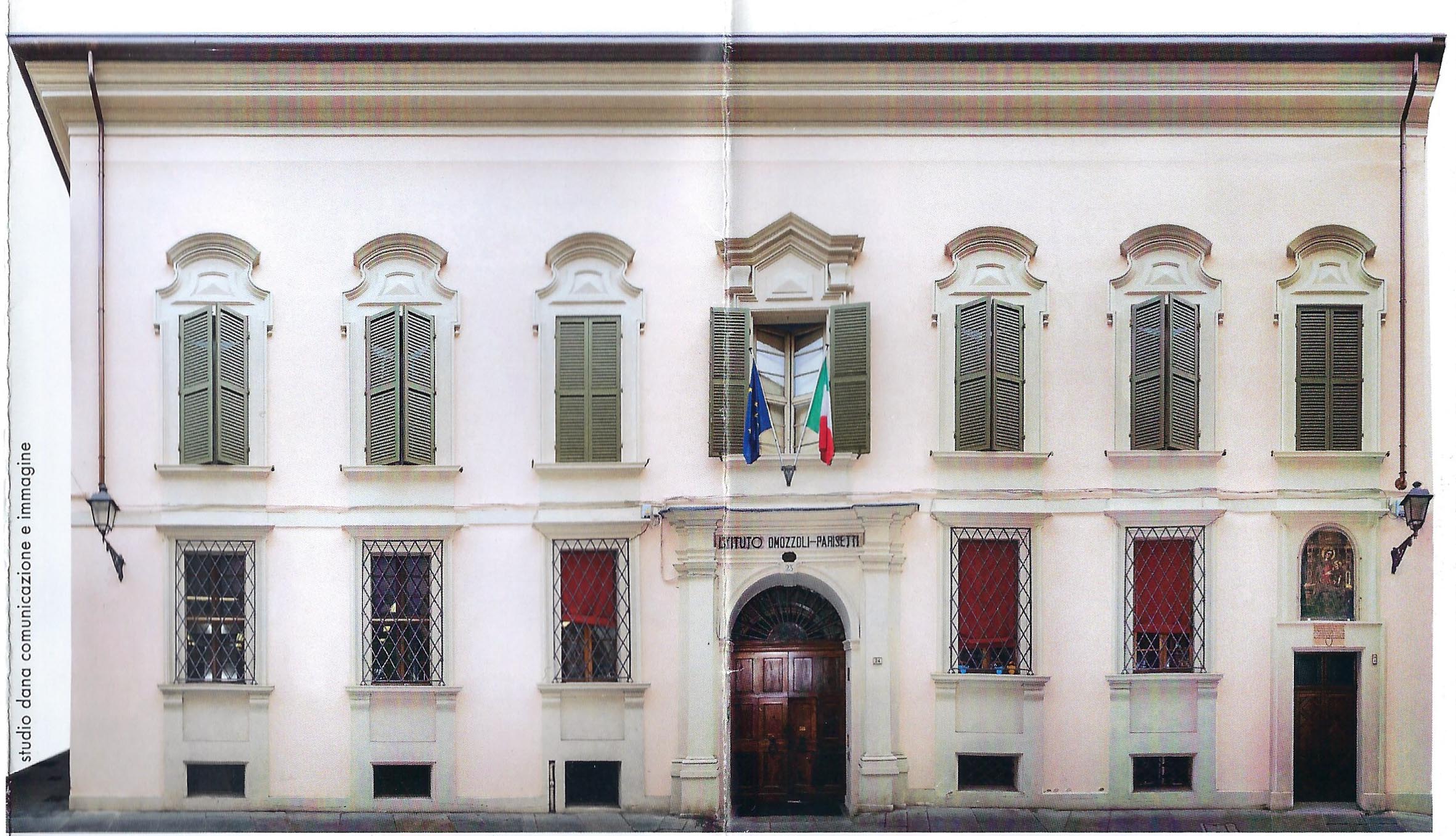
The Omozzoli Parisetti Hospital is located on Via Toschi, in the historic centre of Reggio Emilia. Together with the Oratory of Saints Pellegrino and Rocco, it preserves one of the city’s oldest testimonies to the tradition of hospitality and charitable care.
Historical Background
The Omozzoli Parisetti Hospital was founded on 15 December 1410 by the notary Matteo Omozzoli under the name Hospitale della Santa Maria della Carità (Saint Mary of Charity). Originally established to accommodate pilgrims, travellers, the poor and the sick, it represents an extraordinary example of historical continuity: more than six centuries later, the institution still fulfils its original mission of care, today operating as a residential facility for older people.
The foundation is closely linked to the Omozzoli Parisetti family, descendants of a merchant lineage that gradually established itself among the most influential families of Reggio Emilia from the fifteenth century onwards. Matteo Omozzoli, who had entered the notarial profession and held important positions in the city’s governing institutions, established the hospital in premises adjoining the family residence, in the neighbourhood of San Raffaele.
The initiative formed part of the medieval tradition of hospitality and Christian charity and was also associated with a votive pilgrimage to Saint Anthony of Vienne. The hospital welcomed pauperes viatores, peregrini et infirmi (poor travellers, pilgrims and the sick), providing shelter, food and assistance. It also distributed alms, provisions and clothing to people in need.
Over the centuries, the institution adapted to changing approaches to social assistance and to the evolving needs of the city.
In 1767, as part of the reforms introduced by Duke Francesco III d’Este, the hospital was suppressed in its original form, and its revenues were redirected towards supporting the poor of Reggio Emilia. Nevertheless, its charitable mission did not come to an end: through successive transformations, the complex has preserved its role as a place of care and hospitality to the present day.
Omozzoli Parisetti thus represents a particularly significant testimony to the history of solidarity in Reggio Emilia, being one of the few historic Italian charitable hospitals still operating on their original premises.
Architecture
The Omozzoli Parisetti complex extends along Via Toschi and includes the former family residence, the rooms historically used for charitable assistance, and the Oratory of Saints Pellegrino and Rocco.
The building features a regularly arranged façade, articulated by two tiers of windows and characterised by a restrained yet elegant architectural style. Its present structure reflects the transformations undertaken over the centuries while preserving important traces of its fifteenth-century origins.
Of particular interest is a marble inscription above the original entrance to the hospital, now corresponding to the entrance to the Oratory, commemorating its foundation on 15 December 1410.
The façade also preserves a fifteenth-century fresco depicting the Madonna and Child, associated with the hospital’s original dedication to Santa Maria della Carità.
These surviving elements provide valuable evidence for understanding the history of the complex and illustrate the relationship between its architecture, charitable function and religious devotion.
The Interior: The Oratory of Saints Pellegrino and Rocco
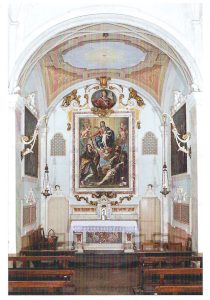
The Oratory of Saints Pellegrino and Rocco was built in 1699 at the initiative and expense of Count Paolo Omozzoli Parisetti, a member of the family whose noble status had been recognised during the seventeenth century.
The building occupies the space originally used as the entrance to the hospital, which was transformed into a place of worship. Both its location and its dedication to the two patron saints of pilgrims and the sick express the close connection between the institution’s spiritual and charitable dimensions.
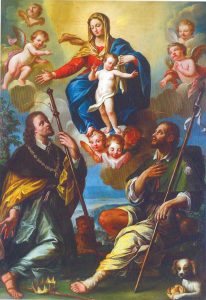
Devotion to Saint Roch also held particular significance in the city’s collective memory, which was still deeply marked by the devastating plague epidemic of 1630.
Artistic Heritage
The interior of the Oratory preserves refined eighteenth-century decoration, characterised by the delicate colours of the walls, white and gilded stucco work, and an elaborate pictorial programme.
Restoration work has brought the decorations back into view and made it possible to appreciate the coherence of the iconographic programme, centred on the themes of pilgrimage and the spiritual journey.

The Oratory’s artistic heritage includes a cycle of paintings depicting episodes from sacred history, united by the recurring themes of travel, encounter and pilgrimage.
Among the works preserved is Saint Philip Baptising the Eunuch of Queen Candace, an episode from the Acts of the Apostles in which a journey becomes an opportunity for encounter and conversion.
Of particular interest is a small oval painting depicting Saint George, rediscovered during restoration work and returned to its original position above the altarpiece.
The saint is portrayed holding a model of the Church of San Pellegrino in Alpe, an important place of devotion and hospitality situated along the historic routes crossing the Apennines, near the Radici Pass.
This representation bears witness to the spiritual and geographical connections between the hospital in Reggio Emilia and the Apennine sanctuary, documenting the historical network of pilgrimage routes.
The Oratory also houses a historic organ dating from 1678.
The Omozzoli Parisetti family also played a significant role in the history of art collecting in Reggio Emilia. Between the seventeenth and eighteenth centuries, the family assembled an important private collection of paintings, including works by leading figures of Emilian painting such as Guercino and Luca Ferrari.
The collection, gradually dispersed between the late nineteenth and early twentieth centuries, reflects the family’s social prestige and cultural interests. Art-historical research has made it possible to reconstruct at least part of its original composition, bringing to light an important chapter in the history of art collecting in Reggio Emilia.
Restoration and Heritage Enhancement
The restoration of the façade and the Oratory, unveiled to the public in November 2019, restored the beauty and historical legibility of one of Reggio Emilia’s most significant heritage sites.
The interventions included the recovery of the original wall colours, the enhancement of architectural decorations and the conservation of the paintings, contributing to a deeper understanding of the complex’s artistic and religious history.
An important role in the preservation and promotion of Omozzoli Parisetti is played by the Associazione Amici Omozzoli Parisetti (Friends of Omozzoli Parisetti Association), founded in 2012. The association promotes cultural initiatives, research activities and public outreach programmes aimed at increasing awareness and appreciation of the building and its heritage.